How to apply a collagen wound dressing, the 6-step protocol
The exact method a wound care nurse uses. With the 4 mistakes that ruin a perfectly good dressing, the size-selection table, and when the wound says you should call a clinician.
 Reviewed byDavid Chahine, MD
In this guide
Before you start, what you'll need
Whether you're caring for a parent with a sacral pressure injury, managing your own diabetic foot ulcer, or recovering from Mohs surgery, the supply list is the same. Have all six items ready before you open anything sterile.
- Collagen wound dressing in the right size (see the sizes below)
- Sterile saline wound wash
- Clean nitrile gloves (sterile not required for most home care)
- Sterile gauze pads for patting dry around the wound
- A non-adherent secondary dressing (foam, gauze pad, or transparent film)
- Hypoallergenic medical tape or a stretch wrap to secure
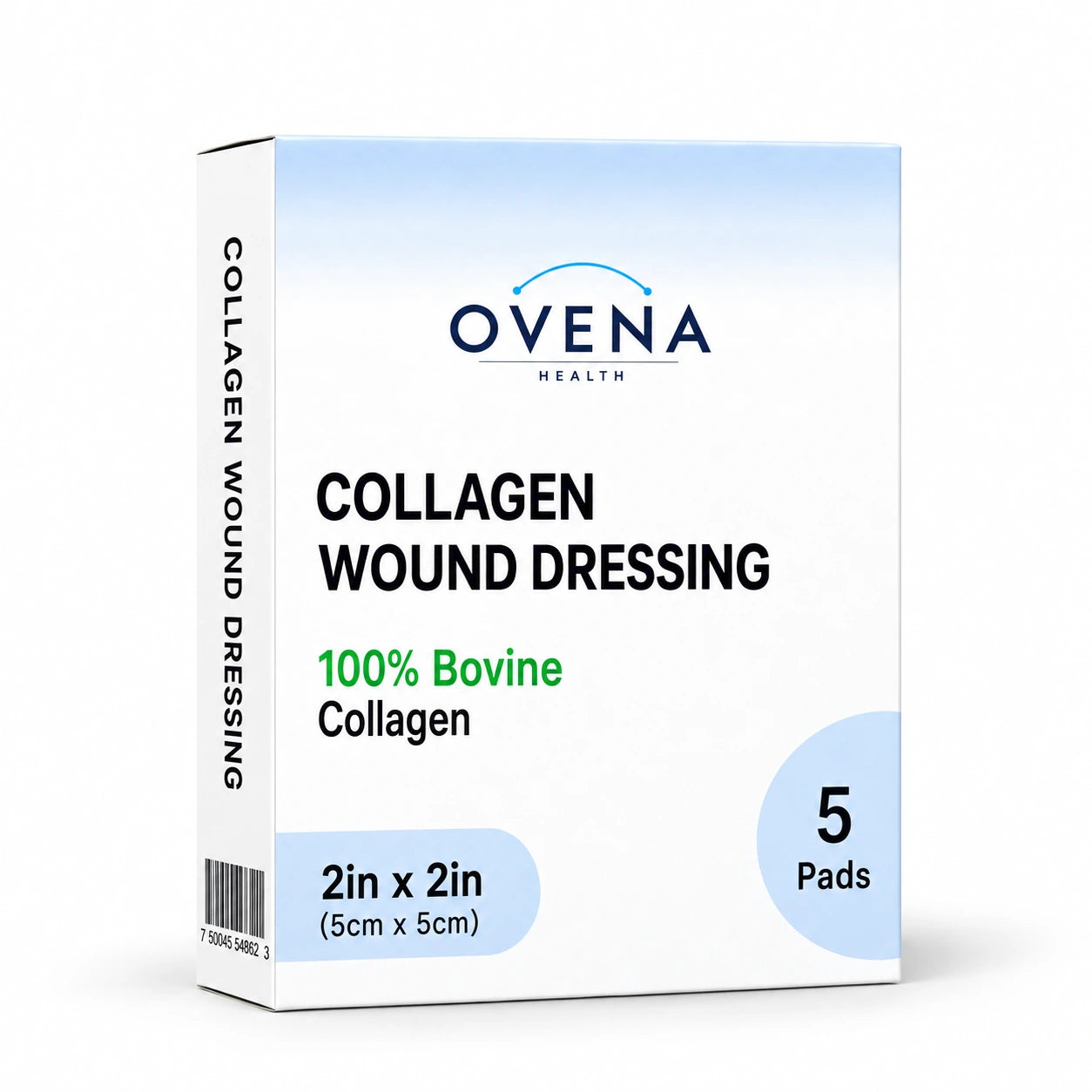
The Ovena Collagen Kit covers four of them — five collagen pads, sterile wound wash, nitrile gloves, and medical tape. The gauze and the non-adherent secondary dressing are not in the box, so have those on hand before you start. If you're piecing the whole list together yourself, double-check that your saline is unopened — once a saline bottle is opened, the manufacturer typically rates it for 24 hours of use.
Choosing the right size
The correct size leaves about a quarter-inch border of intact periwound skin around the wound edge. Too small and you don't fully cover the bed. Too large and you waste a lot of collagen and risk maceration of the surrounding skin.
- 2x2 — post-Mohs sites, biopsy sites, finger ulcers, small partial-thickness wounds
- 4x4 — most diabetic foot ulcers, mid-sized surgical wounds, sacral pressure injuries, drain sites
- Powder — shallow irregular wounds and contours where a flat sheet won't sit down. Do not pack powder into a tunnel or under an undermined edge at home; a tract needs a clinician.
If you can't decide between two sizes, go up. A 4x4 sheet trimmed down with sterile scissors covers a 3x3 wound perfectly fine. A 2x2 sheet can't be made bigger. A wound larger than a 4x4 sheet belongs in a plan your clinician sets rather than a home patchwork of sheets.
The 6-step application protocol
This is the order wound care nurses actually use in practice. The order matters: rushing step 2 (cleansing) is the most common reason a chronic wound stays stuck.
Step 1: Wash your hands and glove up
Soap and water for a full 20 seconds, dry thoroughly, then put on clean nitrile gloves. If you're caring for someone else's wound, this also protects you from any bacteria in their wound drainage.
Step 2: Cleanse the wound with saline
Irrigate the wound bed with sterile 0.9% saline. Squeeze the bottle to flush debris and old drainage out — don't just dab. Do not use hydrogen peroxide or alcohol on a chronic wound — they damage the cells doing the healing along with the bacteria. Iodine does not belong on granulating tissue either, though a clinician may deliberately use it to keep dry, stable eschar dry; that is their call to make, not a home decision.
Step 3: Pat the surrounding skin dry
Use a sterile gauze pad to pat the skin around the wound dry. The wound bed itself can, and should, stay slightly moist. Drying the periwound skin is what lets the secondary dressing's adhesive grip properly.
Step 4: Cut the collagen to size
Use clean (or sterile, if available) scissors to trim the collagen sheet so it has about a quarter-inch overlap beyond the wound edge. Once a dressing is opened it belongs to that one change — discard the trimmings and whatever is left over rather than saving them for next time.
Step 5: Apply collagen directly to the wound bed
Place the sheet onto the wound bed and smooth it down with a sterile cotton-tipped applicator. Full contact with the wound bed matters — air pockets between the collagen and the tissue prevent the matrix metalloproteinase (MMP) binding that makes collagen work. If you're using collagen powder, sprinkle a thin even layer covering the entire bed.
Step 6: Cover with a secondary dressing
The collagen is your primary dressing — it does the work. The secondary dressing keeps the collagen in contact with the wound bed, manages exudate, and protects the area from outside contamination. A non-adherent pad or foam works for most wounds. Secure with hypoallergenic tape or a self-adhering wrap. Change every 2-3 days; see our companion guide on how often to change a collagen dressing.
4 mistakes that ruin a perfectly good dressing
- Cleansing with hydrogen peroxide. It bleaches the wound clean, and bleaches your healing cells along with it. Use saline.
- Applying collagen to an infected wound. Collagen creates a moist environment, which makes infections worse, not better. Treat the infection first under clinician guidance (topical or systemic antimicrobials), then resume collagen.
- Wrapping too tight. A tight wrap restricts blood flow to the wound bed, exactly what you don't want. The wrap should hold the dressing in place, not compress.
- Changing the dressing every day. Too-frequent changes physically disrupt the new tissue forming under the collagen. Stick to the 2-3 day cadence unless the secondary dressing saturates.
What to expect after application
Over the first 24-48 hours the collagen sheet slowly turns into a gel as it absorbs wound fluid and binds the MMP enzymes that were stalling healing. By the time you change the dressing, you'll often see the collagen has partially or fully gelled — that's expected, and it is the sign the dressing is doing its job.
What you should not see is itching, burning, or a new rash where the dressing sits. That can be a reaction to bovine collagen: take the dressing off, rinse with saline, and call your clinician. You should also not see sudden increased pain, foul odor, hot or red surrounding skin, or fever — those are signs of infection. See the When to call a clinician section.
Troubleshooting
The dressing won't stay in place: The secondary dressing isn't tacky enough, or the surrounding skin is too moist. Pat the skin drier and consider a self-adhering wrap.
The collagen sheet keeps lifting at the edges: Lightly mist the sheet with saline before applying so it sticks better to the wet wound bed.
I see pieces of collagen still on the wound at change time: Normal. The collagen is designed to be gradually absorbed. Anything that hasn't been absorbed stays where it is — put the new dressing on over it rather than trying to scrape it out.
The wound looks worse after a few changes: "Worse" can be misleading. Granulation tissue (the new pink/red tissue) often initially looks like the wound has expanded as slough and necrotic tissue lift off. If you're worried, photograph the wound at each change so you can compare objectively, and ask your wound clinician.
When to call a clinician
- Thick, foul-smelling discharge (yellow, green, or gray with odor)
- Surrounding skin is hot, red, or the redness is spreading
- You develop a fever, chills, or feel unwell
- You can see bone, tendon, or fat in the wound
- The wound is tunneling under the skin, or a probe slides under the wound edge
- Itching, burning, or a rash where the dressing sits
- The wound has shown zero improvement after 2 weeks of consistent care
- The wound has been open longer than 4 weeks. That calls for an assessment — circulation, infection, and a biopsy if your clinician thinks one is indicated — rather than another month of the same dressing. Collagen can be part of the plan your clinician sets from there.
If you have diabetes, peripheral arterial disease, or a weakened immune system, treat fever, spreading redness, or a probe that touches bone as an emergency: go to an emergency department the same day, not urgent care. Those infections can threaten a limb within a day or two, and an emergency department can image the area, draw labs, and start intravenous antibiotics in one visit.
Ready to start?
Our collagen dressings and powder are FDA 510(k)-cleared, the same regulatory class wound clinics use, and available without a prescription. Not for use if you are allergic to bovine (beef-derived) products. These items are commonly FSA/HSA eligible; your plan administrator decides, and a letter of medical necessity may be required. We provide an itemized receipt on request.
Shop collagen wound dressings →Frequently asked questions
Do I need sterile gloves to apply a collagen dressing at home?
Can I use tap water to cleanse the wound?
How long does the collagen dressing stay in place?
What if the dressing won't stay flat against the wound bed?
Can I remove the dressing if it's stuck?
Sources
- Fernandez R, Green HL, Griffiths R, Atkinson RA, Ellwood LJ. Water for wound cleansing. Cochrane Database Syst Rev. 2022;9(9):CD003861.
- Brett DW. A Review of Collagen and Collagen-Based Wound Dressings. Wounds. 2008;20(12):347-356.
- WOCN Society. Guideline for Prevention and Management of Pressure Ulcers (Injuries). 2016.
- FDA 510(k) Database. Class II, Wound dressing, collagen. Product code KGN.