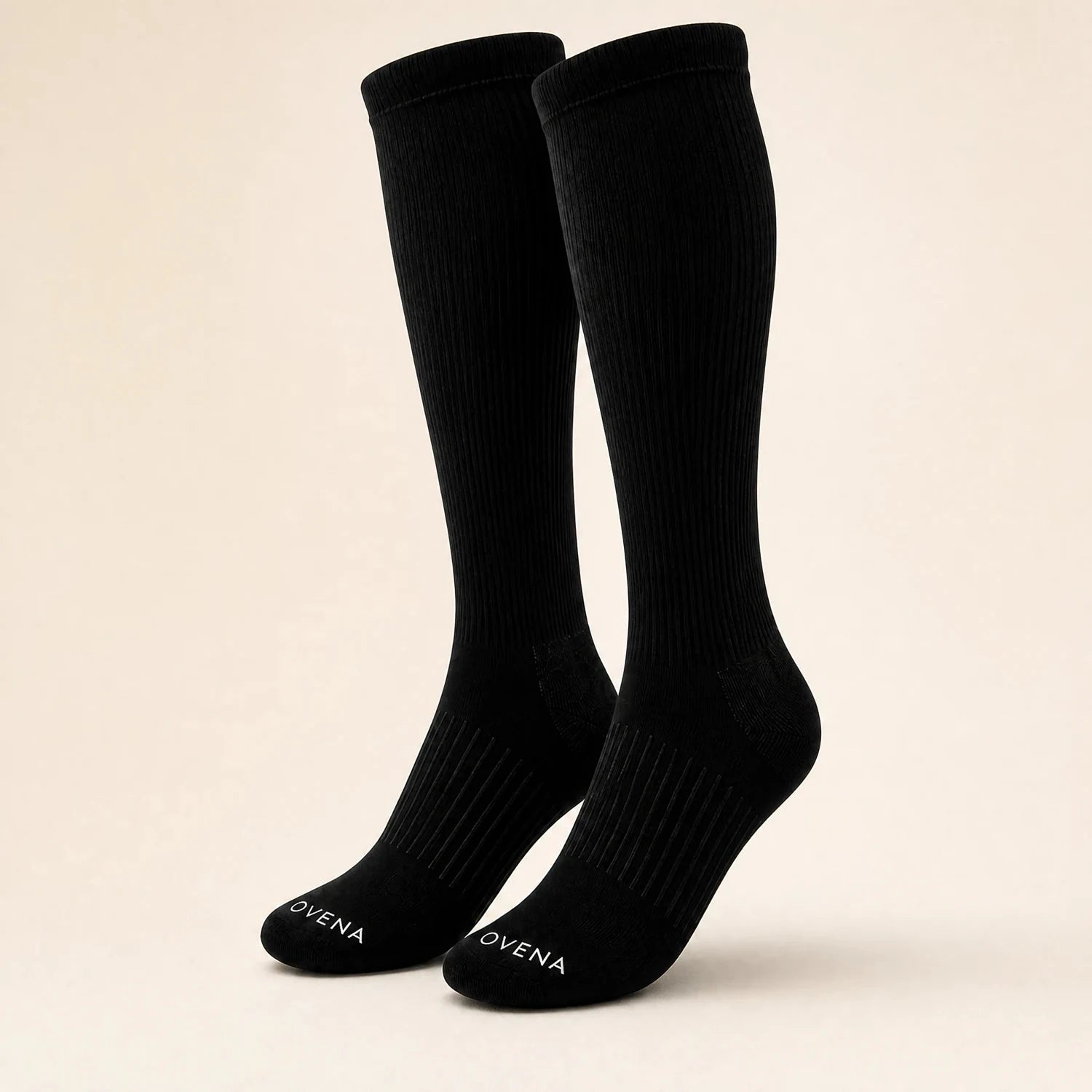
Post-surgical compression socks, recovery guide
When to wear compression after hip, knee, abdominal, or pelvic surgery, what mmHg to choose, how long to wear them, and how to put them on safely.
 Reviewed byDavid Chahine, MD
In this guide
Why compression matters after surgery
Surgery + immobility = elevated DVT risk. The first 2-4 weeks post-op are the highest-risk window, with risk continuing meaningfully out to 12 weeks for major orthopedic procedures. Three factors compound:
- Immobility. Bed rest, limited weight-bearing, and reduced calf-muscle pump action mean venous blood pools.
- Hypercoagulable state. Surgery itself activates clotting cascades for days afterward. Tissue trauma and inflammation both push blood toward clotting.
- Endothelial injury. Surgery near vessels (especially hip and knee replacement) physically irritates vein walls, providing nidus sites for clot formation.
For surgical inpatients, the American Society of Hematology's 2019 VTE prevention guidelines favor pharmacologic prophylaxis, and point to mechanical prophylaxis (graduated compression stockings or intermittent pneumatic compression) mainly for patients whose bleeding risk rules the drugs out (1). Compression socks are the mechanical piece many patients continue at home after discharge, when their surgeon asks for it.
By procedure, what's commonly asked for
There is no single standard here. The durations below are ranges commonly given by surgeons, not a rule — follow your surgeon's instruction, which is the one written for your procedure, your risk factors, and your hospital's protocol.
- Hip replacement / hip arthroplasty: compression on the non-operative leg starting immediately. The operative leg gets compression as soon as the surgical dressing allows, often two or three days after surgery. Commonly 4-6 weeks total, often paired with pharmacologic prophylaxis (aspirin, low-molecular-weight heparin, or a DOAC).
- Knee replacement: similar to hip, commonly 4-6 weeks. Some protocols start the operative leg in compression at the first dressing change.
- Abdominal surgery (open or laparoscopic): compression starting before or during surgery (pneumatic compression sleeves in the operating room and recovery), a bridge to anti-embolism stockings in hospital, then compression socks at home, commonly for 2-4 weeks.
- Pelvic surgery / hysterectomy: same as abdominal, often emphasized given the higher baseline DVT risk in some pelvic procedures.
- Bariatric surgery: commonly 4-6 weeks, with both mechanical and pharmacologic prophylaxis given the higher baseline DVT risk.
- Spine surgery: commonly 2-4 weeks. Some surgeons specify longer for fusion procedures.
- Cardiothoracic surgery: protocols vary widely. Follow your surgical team's instruction rather than a generic range.
- Outpatient soft-tissue procedures (small lipomas, simple excisions, and the like): usually not required unless you have additional DVT risk factors.
Which mmHg level post-op
Two classes are commonly used post-op:
- TED hose (anti-embolism stockings, ~10-18 mmHg) — what the hospital puts on you. They are made for patients lying in bed, at a lower pressure because they're worn around the clock. Use these only as your discharge team specifies.
- 20-30 mmHg graduated compression socks — the usual class for ambulatory recovery once you're up and walking, and what most patients transition to in the days to first week after discharge. The firmer gradient is the one built for an upright leg working against gravity.
15-20 mmHg is an acceptable middle option if you can't tolerate 20-30 mmHg compression, though most patients can. Use 30-40 mmHg only if your surgeon specifies it, typically for patients with substantial venous insufficiency or a history of DVT.
How long to wear them
During the day: from waking until you sit down in the evening. Take them off at night unless your discharge instructions say otherwise (true 24/7 wear is typically only the first few days post-op while still in the hospital).
For how many weeks total: see By procedure above. The same surgeon-given ranges, boiled down:
- Minor surgery, ambulatory same-day: 1-2 weeks
- Major abdominal, pelvic, or spine surgery: 2-4 weeks
- Hip or knee replacement: 4-6 weeks
- Multi-procedure or high-risk patient: longer, as your surgeon directs
How to put them on after surgery (especially hip/knee)
This is the practical problem most post-op patients struggle with. You can't bend over to your foot after hip or knee replacement. Three solutions:
Have a caregiver help
Easiest the first 1-2 weeks. The caregiver puts the sock on while you sit on the edge of the bed with your leg slightly elevated.
Use a sock aid donning device
A sock aid is a curved plastic channel with pull cords, built for exactly this problem: you wrap the sock around the channel, drop it to the floor, slide your foot in, then pull the cords upward. You don't have to bend past 90°. Occupational therapists often send total joint replacement patients home with one. Our sock aid is built for 20-30 mmHg compression specifically.
Use the inside-out method (when you've regained some flexibility)
Turn the sock inside out down to the heel, slip your foot in, then roll the leg portion up. Once you can bend ~60-70° at the hip, this works.
- Persistent unilateral calf or thigh pain, especially deep, with cramping quality
- Unilateral leg swelling (one calf measurably larger than the other)
- Warmth and redness along a calf or thigh
- Shortness of breath, chest pain, or coughing up blood — possible pulmonary embolism. Call 911 or go to the emergency department.
DVT risk persists for ~12 weeks after major surgery, so these symptoms warrant urgent evaluation even if it's weeks out from your procedure.
Recovery-grade compression
Ovena's 20-30 mmHg knee-high graduated compression, in sizes S-XL. Commonly FSA/HSA eligible, though your plan administrator decides. Free shipping over $75.
Shop compression socks → Shop the sock aid →Frequently asked questions
How long after surgery should I wear compression socks?
Can I wear them to sleep?
What mmHg level after surgery?
Do I need them on both legs even if surgery was just on one?
Sources
- Anderson DR, Morgano GP, Bennett C, et al. American Society of Hematology 2019 guidelines for management of venous thromboembolism: prevention of venous thromboembolism in surgical hospitalized patients. Blood Adv. 2019;3(23):3898-3944.
- Sachdeva A, Dalton M, Lees T. Graduated compression stockings for prevention of deep vein thrombosis. Cochrane Database of Systematic Reviews 2018, Issue 11. CD001484.
- Mont MA, Jacobs JJ, Boggio LN, et al.; American Academy of Orthopaedic Surgeons. Preventing venous thromboembolic disease in patients undergoing elective hip and knee arthroplasty. J Am Acad Orthop Surg. 2011;19(12):768-776. https://doi.org/10.5435/00124635-201112000-00007